By GiveGrove• 9 min read • Published 2026
The silent auction closes at 8:30. With paper bid sheets, that's when the line starts: a volunteer at a folding table, a card reader, a cash box, and a few winners who already left and now need a phone call. Software that emails winners an invoice doesn't get rid of the line. It just moves it to your inbox, where some people pay that night and the rest need reminders into next week.
The best platform for silent auctions makes that whole step go away. It closes bidding on its own at the time you set, charges every winner's card automatically, and sends each winner a receipt, all without anyone on your team pressing a button. Mobile bidding and outbid alerts are standard across silent auction software now. How a platform handles the close is where they actually differ.
GiveGrove, the fundraising event platform, does all three, and doesn't charge extra for any of it. It's one of the GiveGrove features customers like most, mostly because there's nothing for them to do.
What should you look for in a silent auction platform?
A good silent auction platform closes the auction for you, collects payment for you, keeps the last few minutes of bidding fair, and tells you what it costs before you sign anything. Almost every platform will show you a nice item page and a mobile bid button in the demo. Ask about these instead:
Automatic closing. Bidding should end on its own at a time you schedule. For in-person events, look for a platform that can also close the auction in step with your program, so you can announce winners from the stage.
Automatic charging and receipts. Winners should be charged to the card they confirmed when they bid, and get a receipt without a staff member sending it. Then ask the follow-up question: does turning this on cost extra? On some platforms it does.
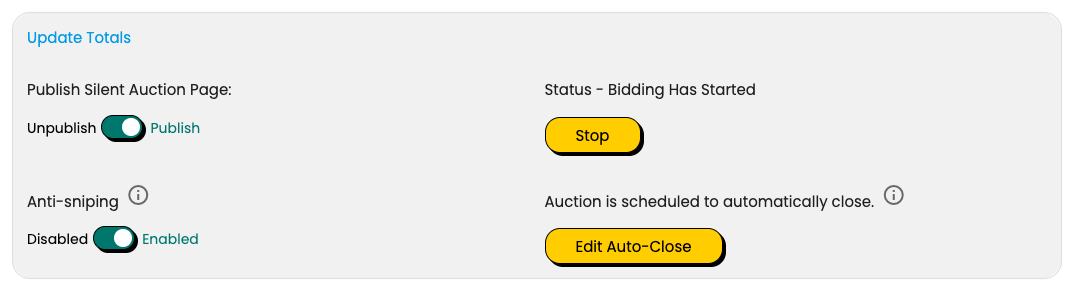
Anti-sniping. When a bid lands in the final moments, anti-sniping adds time so the person who was outbid gets a chance to answer. Without it, last-second bids end the competition instead of starting it. On GiveGrove it works per item: a bid in the last two minutes extends bidding on just that item, with its own timer and flames, while every other item closes and charges on time. Your team can start handing out items while the few still in play keep raising money.
Max bids and outbid texts. Bidders should be able to set a maximum and walk away, and get a text when someone passes them. On GiveGrove, about a quarter of all silent auction bids come in during the final hour, so the alert that pulls people back matters.
A way to text every bidder. One message in the final hour ("20 minutes left, the wine basket is still at its starting bid") is one of the highest-return things you can do on auction day.
Pricing you can read on the website. No contract, no upfront cost, and no quote you have to sit through a sales call to get.
If a platform checks every box but the second one, keep looking. Collecting payment is the job nobody on the committee wants, and it's the easiest one to hand off completely.
How do auto-close and automatic charging work on GiveGrove?
On GiveGrove, the silent auction closes itself at the time you schedule, every winner is charged automatically, and every winner gets a receipt the moment their card is charged. Bidders who opt in to text alerts, which most do, also get a won-item alert by text, and anyone can opt out of platform texts. Your team doesn't run checkout or collect a single payment. The only thing left for staff is handing people their items.
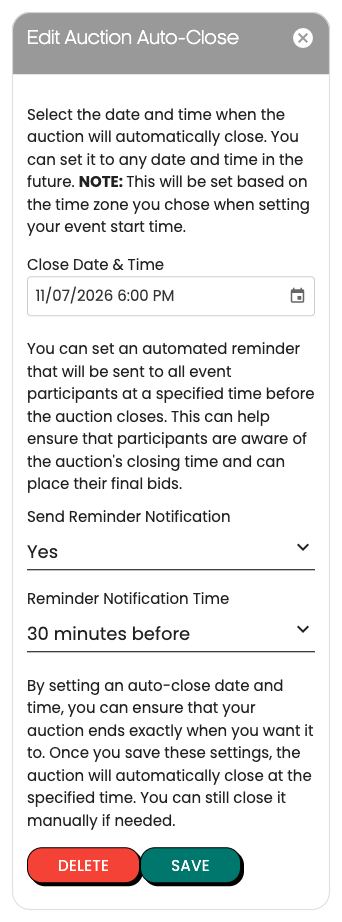
When a guest places a bid on GiveGrove, they confirm their payment information at the same time. Guests can also set a max bid and let GiveGrove bid for them up to that amount. When the clock runs out, GiveGrove charges each winner's card for what they won, and sends the receipt as soon as each charge goes through. You can set the auction to close at a specific date and time, or in sync with your live event.
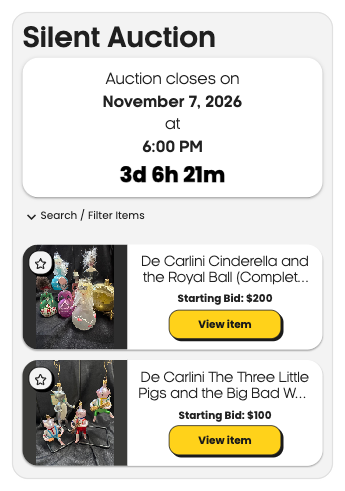
Take a school foundation running 40 items at its spring gala. If the auction closes at 8:30 and 36 items sell, that's 36 charges and 36 receipts nobody on your team has to send. Nobody on the committee is matching bid sheets to credit cards at midnight, and nobody is emailing winners on Monday to ask them to pay.
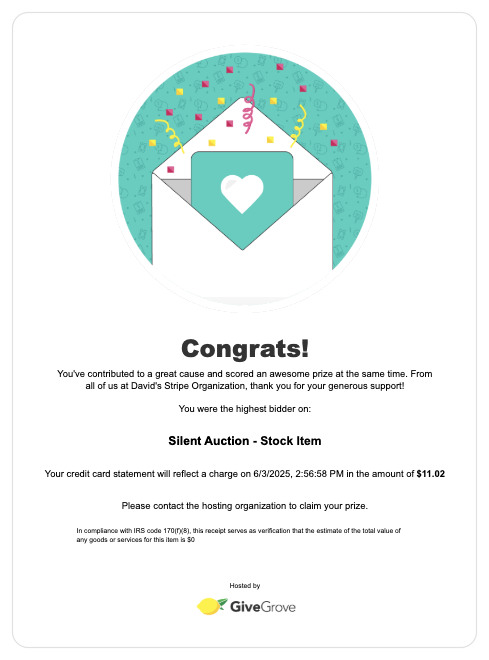
The automatic version matters because collection drops once people leave. GiveGrove sees this in its live auctions, where winners are billed with a charge request instead of charged automatically: about 15% of live auction charge requests from 2025 were still marked pending. Silent auctions on GiveGrove don't have that gap, because there's no request to ignore.
GiveGrove doesn't charge extra for auto-close or automatic charging. Every GiveGrove silent auction charges winners automatically, and both features come with either pricing model (more on those below). Every silent auction has an auto-close toggle, and your organization picks the close time. We encourage every group to set one.
Two timing choices help the close go smoothly. Schedule the auto-close to end before your in-person event wraps up, not at the same minute, so there's time to announce winners and hand out items while guests are still in the room. And keep the silent auction from closing in the middle of a live auction or paddle raise, since the two end up competing for the same attention.
How do the top silent auction platforms compare on closing and payment?
GiveGrove and Zeffy both close the auction and charge winners automatically at no extra cost. Givebutter emails winners an invoice by default, and charges a platform fee if you switch on auto-charge. Here's how the three line up as of November 2026:
| GiveGrove | Givebutter | Zeffy | |
|---|---|---|---|
| When bidding closes | At a set time, or in sync with your live event | At the date and time you set | At the date and time you set |
| How winners pay | Charged automatically at close, with a receipt and won-item alert | Emailed payment request by default; auto-charge is a setting | Charged automatically at close, with a receipt by email |
| Extra cost to auto-charge | None | 3% platform fee on auto-charged transactions (5% on legacy accounts), plus 2.9% + 30¢ processing | None |
| Anti-sniping | Yes, per item: a bid in the last two minutes extends just that item, and the rest close and charge on time | Yes, "popcorn bidding" adds time per item | Yes, extends 3 minutes per late bid, up to 30 |
| Platform fee | 0% on GiveBack (optional donor tips, up to 10% shared back with you), or 4% capped at $4,000 per event on Classic | Free with optional donor tips; 3% if tips are off | 0%, funded by optional donor tips |
On Givebutter, that 3% adds up. A silent auction that brings in $10,000 through auto-charge pays $300 in platform fees before card processing. You can avoid it by sending invoices instead, but then you're back to chasing payments.
Zeffy deserves a fair look, especially for an online-only auction. It's free, it auto-charges, and bidders don't need an account. GiveGrove is built around the event night itself: the auction can close with your program, bidders get outbid texts, and your silent auction, live auction, paddle raise and ticketing all run in one event. GiveGrove also offers training, and you can hire a GiveGrove Liaison to be at the event if you want an extra set of hands.
If you're comparing a platform that prices by quote, such as OneCause, ask two questions on the demo: are winners charged automatically, and does that cost extra?
How much does silent auction software cost?
Silent auction software can cost nothing at all, and you shouldn't have to pay more to have winners charged automatically. The things to watch for are annual contracts, setup fees, prices you only get on a sales call, and add-on fees for features that should be standard.
GiveGrove's pricing works two ways, and you pick per event. On the GiveBack Guarantee, GiveGrove charges no platform fee. Donors are offered an optional tip at checkout, and when they tip, GiveGrove shares up to 10% of that tip back with your organization. On Classic, there's no tip prompt and GiveGrove charges 4% of transactions, capped at $4,000 per event. You can ask or require donors to cover that fee, and on average 85% to 90% of them do.
Either way there's no contract, no upfront cost and no subscription, and payouts land in your bank account every two business days. Auto-close and automatic charging are included in both.
How do you set up a silent auction that raises more?
Open bidding three to five days before the close, leave anti-sniping on, start bids at 20% to 40% of an item's fair market value, and send three reminders. In GiveGrove's data from more than 200 completed silent auctions, timing and promotion are the biggest levers an organization has.
The bidding window trips people up because longer feels safer. It isn't. On GiveGrove, auctions that run three to five days earn the most, and auctions open two weeks or longer earn about half as much. Bidders watch and wait, so a long window mostly ends up losing urgency. You can still publish the auction page early so people can browse and share it. For the school foundation's Saturday gala, that might look like posting the page two weeks out, opening bidding sometime Monday to Wednesday morning, and closing at 8:30 Saturday, before the program ends.
Starting bids work the same way. A low start gets the first bid in, and once two people want the same thing, the price takes care of itself. Items on GiveGrove close at a median of about twice their starting bid. Items that start at 75% of their value or higher sell only a little over half the time, likely because nobody wants to go first at nearly full price. Anti-sniping keeps that competition going to the end, and auctions that use it see more total bids and more bidding wars.
Then promotion. Most organizations send one reminder. Three works better: when bidding opens, at the halfway point, and in the final 24 hours or final hour. A quarter of all bids land in that last hour. Last year's bidders are the best place to start, since they already have accounts and care about the cause. On GiveGrove, repeat bidders spend about 36% more per person than first-timers.
As for items, wine, dining and gift cards are the safe bets, selling for close to full value or better on average. Cosmetic, dental and medical services are a tougher sell, partly because few people want to bid on them in front of their friends.
Silent auction platform FAQ
What is the best free silent auction software?
GiveGrove and Zeffy both run silent auctions with no platform fee to your organization and charge winners automatically at no extra cost. GiveGrove's GiveBack Guarantee also shares up to 10% of donor tips back with you. Givebutter is free when you invoice winners, but adds a 3% platform fee if you turn on auto-charge. Invoicing also puts the work back on your team: someone has to send the invoices, track who has paid, and follow up with winners who haven't.
How do silent auction winners pay with mobile bidding?
It depends on the platform. On GiveGrove, bidders confirm their payment information when they bid, and winners are charged automatically when the auction closes and get a receipt. Some other platforms email winners an invoice to pay on their own, which leaves your team following up with anyone who doesn't.
Do bidders need an account to bid on GiveGrove?
Yes. Guests create a GiveGrove account to bid in a silent or live auction. Plenty of them already have one: on GiveGrove, 38% of bidders at any given event have bid on the platform before.
How long should an online silent auction run?
Three to five days. On GiveGrove, that window earns the most, and auctions that stay open two weeks or longer earn about half as much. Publish the page early if you want people browsing, but keep the bidding window short. GiveGrove can also give you a coaching document with marketing ideas, a timeline and goals, along with a prediction of how much your auction will make.
Can a silent auction close during an in-person event?
Yes. GiveGrove can close the auction at a set time or in sync with your live event. Schedule it to end before the event wraps up, so you can announce winners and hand out items while guests are still there, and avoid closing it in the middle of a live auction or paddle raise.
Picking a platform for your next silent auction
When you sit through demos this season, skip past the item pages and ask what happens at 8:30. Does the auction close itself? Is every winner charged without anyone on your team touching it? Do they get a receipt? And does any of that cost extra?
On GiveGrove the answers are yes, yes, yes and no. To see how it would work for your own event, create a free GiveGrove event page or reach out to the GiveGrove team with questions.
GiveGrove makes events and auctions for fundraising easy. Email info@givegrove.com for more info. Click here to sign up for our mailing list.