By GiveGrove• 9 min read • Published 2026
A nonprofit event sponsorship is a payment from a business, family or individual that underwrites your event in exchange for public recognition and, usually, a few seats. Because you sell sponsorships ahead of the event, that money can land when you need it most, like the month the venue deposit is due and ticket sales haven't picked up yet.
The easiest way to sell sponsorships is to put them where your supporters are already buying. When the sponsor level sits one line above the regular ticket, the couple who planned to buy two seats can move up to a sponsorship in the same checkout. No invoice, no pledge form, no chasing a check in December.
What is a nonprofit event sponsorship?
A nonprofit event sponsorship is money (or sometimes goods or services) given to underwrite one specific event, in return for being thanked in public. That thanks looks like a name in the program, a logo on the slideshow, a mention from the podium and, at most galas, a table or a pair of tickets.
Recognition is what separates a sponsor from a donor. A donor can give and never be named. For a sponsor, being seen supporting the cause is part of the deal, and most of the local businesses you'll ask are thinking about both things at once.
A sponsorship also isn't advertising, and the IRS cares about where that line falls. Thanking a sponsor by name and logo keeps the payment in sponsorship territory. Promoting their products starts to look like an ad sale (IRS). There's more on the tax side further down.
| Donation | Event sponsorship | Advertising | |
|---|---|---|---|
| What the giver gets | A thank-you and a receipt | Name or logo recognition, plus any tickets in the package | Promotion of their products or services |
| Tied to your event | Not necessarily | Yes | Not necessarily |
| Tax treatment for the nonprofit | Not taxable | Generally not taxable when it's acknowledgment only | Can be taxable as unrelated business income |
How should you price sponsorship tiers?
Price your top sponsorship to cover one big, visible cost (the venue, the band, dinner), then step down by roughly half at each level until you hit a price a small business or a family can approve without a meeting. Four to six levels is plenty.
The Junior League of South Bend, which has hosted a Holiday Ball since 1927, published the sponsor list from an earlier ball, and it shows how this plays out. Here's the ladder it published (JLSB):
| Level | Price |
|---|---|
| Diamond | $7,500 |
| Gold | $5,000 |
| Silver | $2,500 |
| Bronze | $1,000 |
| Friend of JLSB | $500 |
| Supporting | Under $500 |
Look at the middle of that ladder. The $1,000 Bronze level drew more sponsors than any other, and most of the League's sponsors came in at $500 or $1,000. Your top tier gets the attention, but your middle tiers carry the volume. The list also mixes local businesses, a health system, a college and plenty of families, which is a good reminder that "sponsor" doesn't have to mean "corporation."
A few things we'd build into any ladder:
Seats that scale with price. A full table at the top level, a pair of tickets in the middle, and recognition only at the entry level.
A limit on the top tier. One presenting sponsor feels exclusive. Five feels like a discount.
An entry level under $500. It's where families, alumni and small shops say yes.
The value of what sponsors receive, written into each level. If a level includes dinner for eight, say what that dinner is worth. Sponsors need it for their taxes, and the IRS expects you to provide it (see below).
How do you sell sponsorships online with GiveGrove?
In GiveGrove, you sell sponsorships by adding each sponsorship level as its own ticket in your event's ticketing, with its own price and a description of the benefits. Sponsors buy online the same way guests do, and every purchase shows up in your event reporting next to your ticket sales. Like ticket buyers, sponsors need a GiveGrove account to check out, so it helps to mention that when you send the link.
Create one ticket per level. Name it plainly ("Gold Sponsor, table of 8") and set the price.
Write the description as the benefits list. Include the number of guests, where the sponsor will be recognized, and the estimated value of the dinner, drinks or other goods sponsors receive.
Put the ticketing link in every sponsor ask. Keep your sponsor packet if you like it, but make the last line a link to the ticketing page instead of a form to mail back.
Use discount codes for early commitments. GiveGrove added ticket discount codes in January 2026, which work well for a returning-sponsor rate with a deadline.
Watch your reporting and follow up. Check who's bought against last year's sponsor list. Anyone missing goes on this week's call list.
Fees hit harder on a $5,000 sponsorship than on a $50 ticket. GiveGrove lets organizations pick between two pricing models. The Classic model charges a 4% platform fee, which would be $200 on that $5,000 sponsorship. The GiveBack model charges organizations no platform fee and instead offers donors an optional tip at checkout (GiveGrove).
How the Junior League of South Bend sells Holiday Ball sponsorships
The Junior League of South Bend sells Holiday Ball sponsorships as ticket options in GiveGrove, so a sponsor checks out exactly the way a guest does. For the 2026 Holiday Ball, the sponsorship levels sit in the same ticketing module as individual tickets.
This isn't new for the League. Holiday Ball has run on GiveGrove since 2021. The 2022 ball at The Armory listed its sponsors right on the GiveGrove event page. The 2024 ball, A Black & White Affair, sold tickets and sponsorships through GiveGrove too (Michiana.Life), and the 2026 ball is back on the platform.
A lot of the pitch writes itself. The Junior League is an organization of women whose mission is advancing women's leadership through volunteer action, collaboration and training (JLSB). So a business that sponsors Holiday Ball is backing local women who train as volunteers and then go to work on community projects. In 2024 the League told sponsors their money would support projects like Hannah's House, Girls on the Run and St. Joseph County Parks.
People in South Bend like supporting women who show up for their city, and they've watched this group do it for close to a hundred years. The very first Christmas dance in 1927 sent $600 of its $900 to the Girls Reserve. The ball still carries that history on the night itself, with the Mary Lou Schwartz Award, presented since 2003 to a local woman whose volunteer work stands out (JLSB).
What other organizations can borrow from the League is mostly mechanical. A sponsorship level is a ticket with a bigger price and a longer description, and it belongs on the ticketing page.
What can you sponsor at an auction or school event?
An auction night has more pieces to sponsor than a dinner-and-dancing event, and each piece can be sold from the ticketing page. Think about the live auction and paddle raise (on GiveGrove, both run in the Live Auction module), the bar, the dessert table, or a sponsor who matches every paddle raise gift up to a set amount.
Schools have one option we especially like: sponsor seats for teachers. The Hudson School in Jersey City built it right into its levels, where several packages include tickets donated to faculty and staff (Hudson School). It gives a family without a business to promote a real reason to sponsor, and it puts the people the event is for in the room.
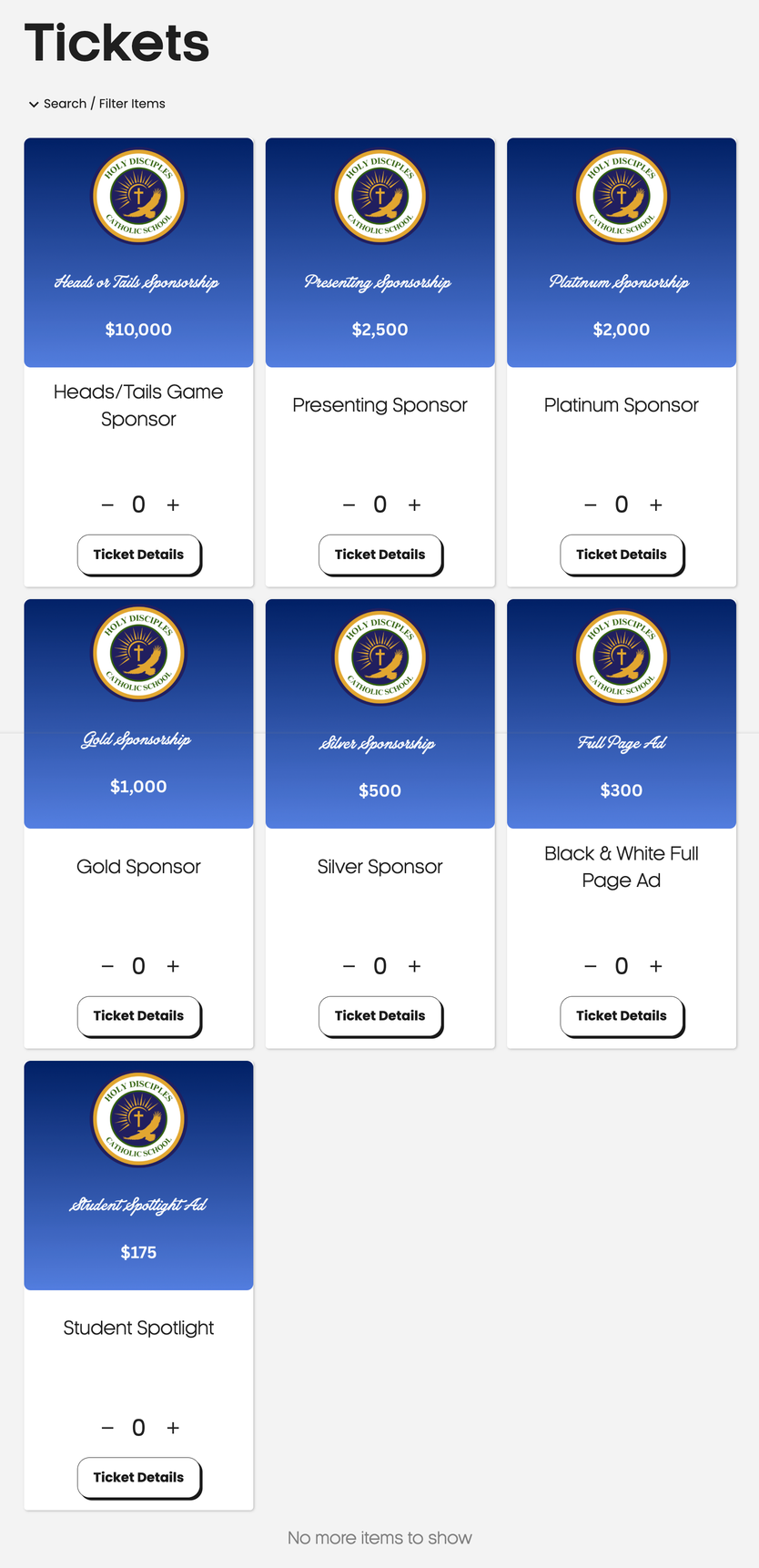
Holy Disciples Catholic School (HDCS) sells sponsorships this way for its Annual Auction Gala 2027, and the page was already selling in October 2026. Its top sponsorship is tied to the auction night itself. The Heads/Tails Game Sponsor, at $10,000, puts a sponsor's name on the heads-or-tails game, where guests stand and guess each coin flip until one person is left. Presenting, Platinum, Gold and Silver sponsorships follow, from $2,500 down to $500.
HDCS sells program ads on the same page, too: a $300 black-and-white full-page ad and a $175 Student Spotlight ad. At those prices, a family or a small shop can get into the program without stretching to a sponsorship. Ads are worth a quick word with your CPA, though, since the IRS treats advertising differently from sponsorship (more on that below).
How do you find and pitch event sponsors?
Start with last year's sponsors, then your board members' employers, then local businesses whose customers look like your guests. A returning sponsor is the easiest yes you'll get all season, so call them first and offer them their old level before anyone else gets it.
Start early. Businesses set giving budgets well ahead of time, so for a December ball the asks should go out by late summer. If it's mid-October and you haven't started, don't panic, but start this week.
When you pitch, lead with who'll be in the room and what the money pays for. Something like "about 300 guests, and your $2,500 pays for the band" lands better than a page of logo placements. Make the ask by phone or in person, then send the ticketing link so they can buy that afternoon.
Then thank them more than once: from the podium, in the program, in a social post after the event, and in a short note a few weeks later telling them what the night raised. That last one is how this year's sponsor becomes next year's renewal.
Are event sponsorships tax-deductible?
Partly. When a sponsor gets something back, like dinner for eight, only the amount above the value of what they received is deductible. For any payment over $75 where the donor receives goods or services, the IRS requires the nonprofit to give a written disclosure with a good faith estimate of that value (IRS).
Here's how the math works on a $1,000 sponsorship that includes two dinner tickets worth $150 each. The sponsor received $300 in value, so $700 is the deductible portion, and your receipt or disclosure should say so. If your event uses the GiveBack model and the sponsor adds the optional tip at checkout, that tip isn't a gift to your organization, so it isn't part of the deductible amount either.
Business sponsors raise a second question. Under the IRS rules for qualified sponsorship payments, simply acknowledging a business by name, logo or address is fine. Language that compares or praises their products, or asks people to buy from them, counts as advertising, and that income can be taxable to your organization (IRS). "Thank you to Main Street Bank" is acknowledgment. "Main Street Bank, South Bend's best rates, stop in today" is an ad.
GiveGrove is a fundraising event platform, not your accountant, so run your sponsor packet past your CPA before it goes out.
Sponsorship FAQ
How much should a nonprofit event sponsorship cost?
Price the top level to cover one major event cost, then step down by about half per level, ending with an entry level under $500. The Junior League of South Bend's published Holiday Ball ladder ran from $7,500 down to $500, with a supporting level below that. Your numbers should follow your own budget and your guests' giving history.
What's the difference between a sponsor and a donor?
A sponsor gives to underwrite a specific event and is publicly recognized for it, often with tickets included. A donor gives to the organization and may never be named. Many supporters are both, and a ticketing page that offers sponsorships makes it easy to move from one to the other.
When should we start selling sponsorships?
Three to four months before the event is a comfortable window, since many businesses plan their giving budgets ahead of time. Ask returning sponsors first. Open sponsorships on your ticketing page at the same time so anyone who says yes can pay right away.
Can individuals and families be event sponsors?
Yes. The Junior League of South Bend's sponsor list mixed local businesses with more than a dozen families and couples. An entry level under $500, or a level that donates seats to teachers or volunteers, gives individuals an easy way in.
Can we sell sponsorships on the same page as event tickets?
Yes. In GiveGrove, each sponsorship level can be set up as a ticket with its own price and benefits description, so sponsors check out the same way guests do. That's how the Junior League of South Bend sells sponsorships for its Holiday Ball.
Thanks for trusting GiveGrove with your fundraisers!
The GiveGrove Team 🍋
A Code Works company
GiveGrove makes events and auctions for fundraising easy. Email info@givegrove.com for more info. Click here to sign up for our mailing list.